These are some of the devices and techniques I use for work. They save me a lot of time from shallow/needless work.
Kanban Boards
This is a helpful visualisation tool for organising your work.
Contrary to common belief, you can only do one thing at once. Multitasking is a myth. Really!
Here is an example (made up):
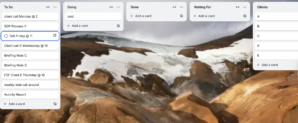
I try to start and finish a task in one sitting.
For cognitively demanding work, like preparing a briefing note for a client or SOP on a complex issue, I separate the task into two.
I’ll do the drafting one day, and then sleep on it, and come back the next day, and edit/revise it.
If you let the memo linger in your draft files for days and weeks, you won’t get it done.
It means on any one day, you will be doing around three things that sap your brain power.
Schedule on Paper/Agenda
Each week, usually on a Friday morning, I check my next 2 weeks ahead.
Here is a typical week (made up).
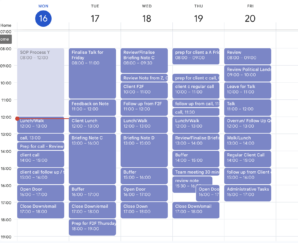
I use my mornings for deep work. My brain seems to work best in the morning, after a good night’s sleep.
Here I’ll schedule time to write and provide feedback, usually via paper and Loom videos.
The goal is 2-4 hours on a single focused task.
After a short time, in quiet, you can get in the zone, where thinking work becomes a lot easier.
I turn off notifications so as not to be interrupted. Interruptions will bring you out of the flow state. It takes you 15 minutes to 30 minutes to get back into flow. If you are constantly interrupted, it is impossible to do deep work.
I have some set items in my agenda.
I have an open door time, colleagues can get hold of me.
At the end of the day, I have a simple routine.
I work on my emails once a day. I’m sure if anything really important comes up, people can get hold of me.
I check my agenda for tomorrow. Maybe something has been rescheduled. A meeting does not have an agenda / pre-read. That gets cancelled.
I also think it allows my brain to work on the items coming up/
I add any upcoming calls/meetings to my calendar and ask for input on them.
I add any lessons learned from the day into a notebook/
I now add useful files from the day into Notebook LM.
And, whilst the day is fresh, I’ll give or ask for feedback.
Agendas and Pre-Reads
For the last 10 years, I have had a simple working rule: “No agenda or pre-reads, I don’t show up”.
This one working rule has saved a lot of my time going into the ether.
If meetings are just about information sharing, this can be shortened/eliminated by providing the information in advance in the pre-read.
Meetings are useful for problem-solving and finding an answer to a complex issue by bringing different skill sets to the table.
If meetings are there to make people feel emancipated or have their voices heard, not for the sake of sharing valuable expertise or intelligence, but for inner self-fulfilment by sharing nothingness, they may be a type of meeting to be too busy for.
Schedule buffer and prep/ follow up
I schedule a buffer for things that just turn up unplanned each day. I find an hour a good guestimate. Somedays you won’t need it. The only downside is that you can work on something else earlier than you planned to.
I tend to schedule time to prepare for a client call/meeting. I do this for 3 simple reasons. First, I don’t have a photographic memory, and this serves as a moment to bring myself up to speed. Second, it gives me a chance to check that everything that was meant to be done has been done. And third, I may have time to make a quick call to someone to find out a missing bit of intel.
I schedule time directly after the meeting to do any follow-up. I do this as the issue is fresh in my memory. I can usually get 50% of what needs to be done answered within an hour or so. I’ll schedule the rest later on in the week.
SOPs/Checklists
I have systemised most of the procedures I work on down to SOPs, Checklists, visual charts and case studies.
It takes a long time to do it, but I think it is worthwhile. It saves me time in the long run.
For the few areas I work on, I just turn to the relevant SOP/Checklist/Visual Chart/Case Study. It tells me, with unnerving accuracy, what to do next, with examples of good practice.
There is no need to spend time reseraching on how to X works in practice. It is all written down. I won’t make things up on the fly or draw guidance from the little people.
NotebookLM is helpful. It saves you time working through your own guidance.
What Are the Next 3 Steps
For each client, policy, legislative and regulatory file I am working on, I have a simple one-pager for each that lists:
1. What are the next 3 things happening (item and date)?
2. What actions are being taken
3. What is the progress on delivery
It is a follow-up on the SOPs/Checklists. My brain has not managed to memorise the 120 steps on an OLP file, for 9 separate clients, or the 800 separate actions that can be taken during the journey of a legislative file.
So, I have put down on paper the next 3 important things that are happening and what actions can be taken.
It reduces the cognitive overload.
Limit Work in Progress
You can only work on a few things at once. Ignore this, and you’ll deliver poor quality work late. The overstretch will soon resolve itself: clients won’t want to work with you.
A lot of lobbyists are sure that their brains can handle the cognitive overload. They are either gifted or maybe they are just kidding themselves.
I limit myself to a few areas where I have accumulated expertise (gained over more than 30 years). I don’t stray outside that narrow circle of competence.
Reference
I add any useful information to my Notebook LM.
I had saved all the ECHA RAC Opinions, European Court cases on chemicals, core working guidelines of the Commission, and all my SOPs/Checklists and case studies.
It helps me find the information that I need. It speeds up research. It can track down the precedents.
I’m switching the information I kept in Evernote to Notebook LM. The questioning function is excellent.
You can’t cheat biology
If you want your brain’s synapses to work well, you need three things: good sleep, air and sun.
If you are not sleeping well, it is as if you are turning up to work heavily intoxicated.
I schedule a walk around lunch time to look for the sun’s rays and get some air in the lungs.
I find walking the best way to find the answer to a question. I carry a small notebook for when this happens. Walking helps me decompress.
I go for a long walk in the morning and evening with an energetic American Stafford. It helps with good sleep and lets answers to difficult questions randomly appear as a squirrel is being chased. Just have a notebook and a pen to jot it down.
Further Reading
Cal Newport, Deep Work