One of the first legislative files I worked on was on Ambient Air Pollution – back in 1997.
I was curious to see how outdoor air pollution levels were going.
So, I turned to the 2019 Evaluation.
The answer appears to be “really quite well”.
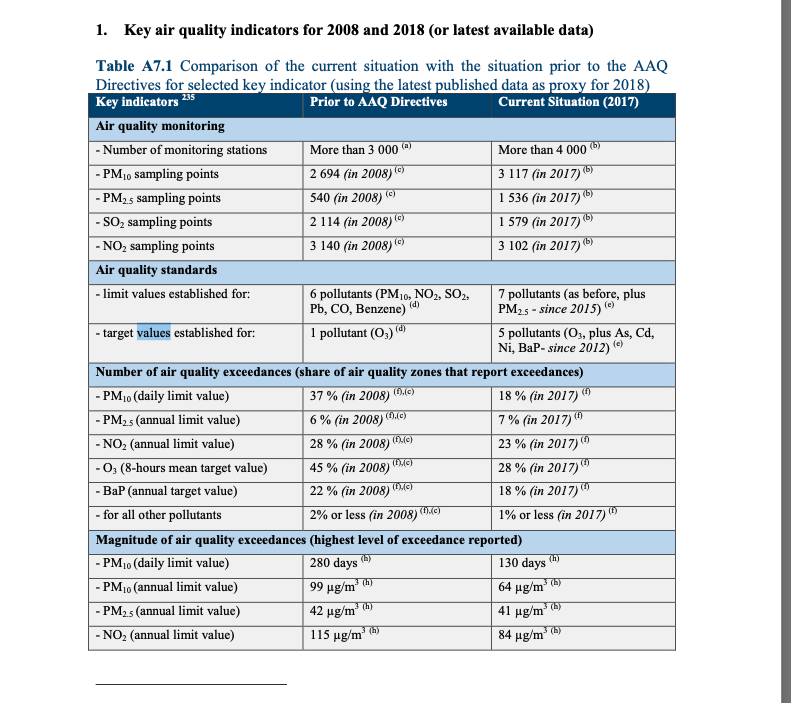
Source Annex 7, page 136.
Now, I recognise things are not perfect. That is a high standard to reach. Even in a state of nature, we will have air pollution. But, gradual improvement. Political decision makers make choices. They make a rough opportunity case. Are the likely benefits worth the likely costs? At a certain point, the opportunity costs become too high to keep increasing the legislative/regulatory standards. An imperfect trade-off off perhaps, but it is a choice policymakers and political decision-makers will make.
Now, I realise air pollution is more advanced in terms of cost-benefit analysis and policy making in general than other areas of environmental policy making, and policy making in general.
And, since 1997 when EU rules were introduced, our economy has not collapsed, as I was warned would happen in a few meetings I sat on as a young political advisor.
I looked at how the EU’s economy has performed since 1996.
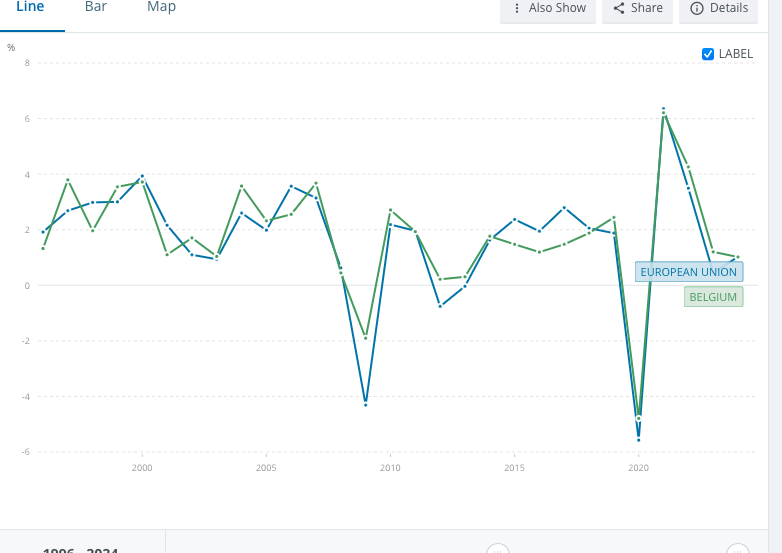
Source: World Bank. GDP growth (annual %)
I added in Belgium because I wanted to see if the enlargement had impacted the data. Nope
There are some big drops: 2008 and 2020 – none caused by air pollution regulation.
You’d have the impression that things were a lot different in the USA.
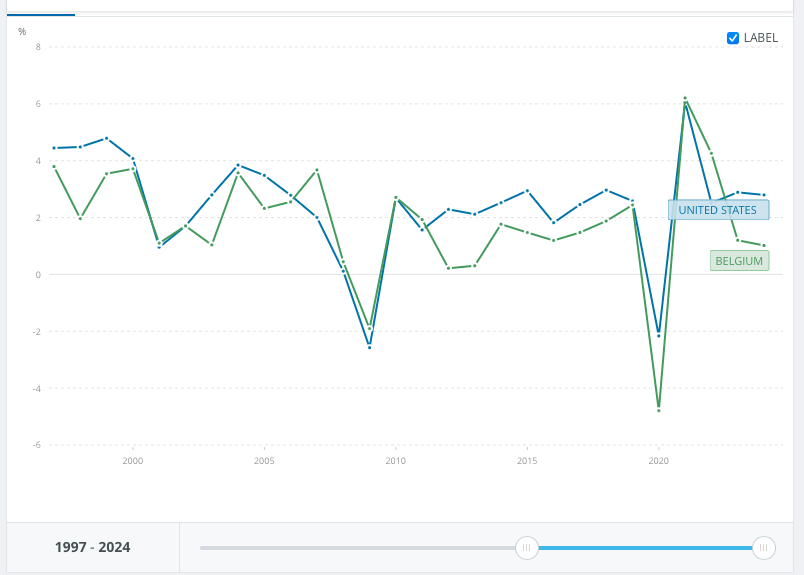
GDP growth (annual %) – United States, Belgium