I was asked for more practical suggestions after this post ‘How to avoid poor public policy writing’.
What follows are most of my tips and tricks.
1. Steps in Writing
These are the steps I tend to follow.
Steps
Step 1: Get the words out. Just get it out the core ideas – the who, what, why, where – onto the paper/screen. This is a brain dump. The polishing comes later.
Step 2: Add in extra information. Add in the details, references, etc.
Step 3: Now go through and put it into the right style.
Step 4: Polish and read it aloud. When you read it aloud, you will hear what is right and what’s wrong.
Step 5: Sleep on it. A good night’s sleep will often reveal an improvement.
Step 6: Ask someone to read it.
They are acting as a good editor to see if words convey the message you intended it to.
Step 7: Final edit.
Make any corrections.
Your first draft is going to be dreadful. Don’t worry. It is normal. The steps going forward will turn it around.
I’ve found the process of ideation, researching, writing, and editing requires different parts of the brain, so I do them at different times.
There may be a better way of doing this.
Steps 4 and 6 can be replaced by your computer reading out the text.
On anything really important, I’ll ask an expert to review at step 6. They’ll always bring something important back.
2. When to write
I find this takes up my brain’s energy. And I’ve realised that over time, my brain’s energy is limited.
On a good day, I can do about 4 hours of cognitively demanding work. That’s usually set aside for (1) writing advisory notes to clients, (2) research into finding a precedent/solution and (3) a deep dive meeting with a client. At the end of 4 hours, my brain synapses are not firing in sync.
I tend to do the cognitively demanding work first thing in the morning, with a second wind at 8 pm. It means I won’t take many meetings until 2 pm.
Focused bursts of 90-120 minutes seem to work best. A deeper piece may be done in one 3-hour sitting.
3. Where to write
I find that writing requires complete concentration.
Good writing needs a quiet place where you can avoid all distractions. So, turn off your notifications and phone, and make sure colleagues don’t interrupt you.
This excludes most open office plan offices that seem unable to follow library rules.
4. What to write
Think about the reader
Don’t overload the reader’s cognitive brain. This is the difference between your ideas being ignored.
Ask yourself this question: How will the reader feel after reading it? Informed, ah ha moment, or confused, lost?
Words
Use simple words and short sentences.
Vary the tempo and don’t repeat the same phrase constantly.
Make sure the language is clear for the intended reader. I have not met many people interested in the finer points of delegated acts – that’s a small policy fetish community. I call them technical laws. For an American client, I’d use the term delegated legislation, as that corresponds to their terminology.
The law of 3
I think that 3 core concepts are the most people can take on board. Anything more, and the brain taps out.
If the issue is complex, I’d stick to one concept. Anything more, and the reader will be left confused, frustrated, and likely angry. You have just wasted their scarce time.
Waterboarding the reader with too much is common and pointless.
5. Use Models
I have a pack of templates and good examples to draw on. It helps when you need inspiration. You don’t want to be creating from scratch all the time.
I use Barbara Minto’s Pyramid Principle. So, most of my advisory notes have this basic structure
Put it all at the start: (SCQA) This is the situation we are in. This is the complication (why it matters to your reader). Question: Is there anything we can do? Answer: If yes, here is how.
Introduction/Background: How we got here/Why it is important.
Point 1 – with supporting facts/evidence
Point 2: with supporting facts/evidence
Point 3: with supporting facts/evidence
Recommendation: 1-3 points. Here are the 1-3 things that can be done.
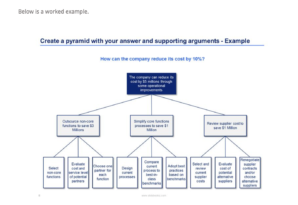
Pyramid Example: Source Barbara Minto
This limits what you can put down on paper. There is no space to mention that you went to the College of Europe with the desk officer, that the Director has a Labrador, or that the MEP is a keen sailor. It forces you to be clear and concise and focus on the essential.
It is important to keep the recommendations in the realm of the legally feasible and politically sane. An amendment from the AfD is not going to change the outcome of the vote. Pushing for a delegated act on an issue that requires a new ordinary legislative proposal is a pathway to nowhere.
6. How to Research Anything
Is it true
Check with 3-5 people who really know the area to see if something is true.
You need to make sure that your advice is accurate.
It can’t be “it is something I thought may be right”, or “I heard it at Place Lux at 1.30 am”, or “It’s something being said on this WhatsApp group”. This sounds like “the spirits spoke to me”.
The best place to research
Books are where they keep the secrets. People put their secrets in books. Books, articles/papers, and talks are information-dense. Books the most.
As many lobbyists don’t read much, you can set yourself apart.
This is what I do when I start work on a new area.
-
Find out what to read: from easy introductory texts to advanced texts.
-
Start with the introductory text. You are trying to get familiar with the technical language that is used and the basic concepts.
-
Work your way up through the texts. Get more familiar with the ideas and the jargon/language that is used.
-
Get to being able to have an informed conversation with an expert.
-
Schedule conversations with experts to see that you understand what needs to be known.
You are not looking at becoming an expert. That takes decades. You are looking to have a good understanding of the matter, be able to ask informed questions, and be able to communicate the essence clearly and concisely.
If you want to get a good idea of what clear communication read Discovery Magazine. Each month, they interview a top scientist who explains their work. You’ll find complex issues can be explained clearly and concisely.
For legislative proposals, this is what I would tend to do to better understand the issue by reading through:
-
The ‘Have Your Say’ feedback
-
The Impact Assessment
-
Studies in the Impact Assessment
-
The consultant’s background reports
-
RSB Opinion
-
Proposal and Explantory Memorandum
-
OECD etc studies
-
Member State submissions
-
Expert studies/commentary
- Explanations by the Commission at Expert meetings and the EP Committee.
As the file advances, it moves onto reading:
- The Draft Report
- Council Position
- Amendment Justifications
- Well-reasoned position papers (remarkably rare)
- Debates /Exchanges
I’m sure there is a quicker way to understand a file reasonably well, I don’t know what it is. Let me know if there is an easier way.
I load all of this information and my notes into an LM Notebook.
7. Test if you understand it
Explain what you are working on to a stranger/a colleague who is not working on your issue.
See if they are interested. Do their eyes light up? Do you make sense?
Another way is to video record yourself explaining the point(s) to your phone. Send it to a friend. Do you make sense, or do you sound manic, like you are on 5 grams of amphetamines and angry?
8. Summary
I suspect this system allows you to deliver each day:
- 2-3 good client notes/interventions/solutions.
- Focused bursts of work of about 90 to 120 minutes. Followed by decompression. I find a walk in nature for 20-30 minutes reenergises the brain.
- A limited number of doable actions a day.
- Non-cognitively demanding work in the PM.
- Slack for the unexpected.