I spent some of Christmas holiday re-reading Farnham Street’s ‘The Great Mental Models’.
Mental models are useful shortcuts to help you understand the world. It is a simplified representation of how something works. They help take many complex ideas and compress them into manageable chunks.
Reciprocity
Reciprocation can be summed up by:
“So in everything, do to others what you would have them do to you, for this sums up the Law and the Prophets.”
Matthew 7:12
This could rephrased to “Do unto others knowing that something will be done unto you”.
It is an idea that has people have tried following for a few thousand years.
It is an idea that appears novel to many lobbyists. It is a useful approach to follow.
Option 1: The Common Approach
Over 30 years, I’ve seen the following when people lobby officials, politicians and others:
Sneering
Hectoring
Insulting
Being Rude
Bullying
Bigotry
Intimidating
Fighting
Stalking
Lying
Cheating
Passing off
Selective referencing
Avoiding the issue(s)/answers to basic question
Messing people around
Not providing the data and evidence that is needed
Handing over false/partial data/evidence.studies
Turning up late
Haggling
Harassing
Time wasting
These actions have always backfired.
What I’ve found interesting is that many lobbyists think many of these actions are okay. The same people seem surprised when they, or their interests, are ignored for many years to come.
They are not practices from a bygone era. They seem to be common practice.
Option 2: The uncommon approach – Reciprocity
It requires the following:
Step in first
With a smile
Provide them with with the information (data, evidence, studies etc) that they want
Provide workable solutions
Make it clear and simple
Be constant over the long term (decades). This is hard. People find constancy hard work. People get lured away by bright shiny objects and new fashions.
Newton’s Third Law
‘For every action, there is an equal and opposite reaction.’
This is mirrored reciprocation. If you are disagreeable to someone, they’ll be disagreeable back. If you are agreeable to someone, they’ll be agreeable back to you.
If you do Option 2, I can’t guarantee that you’ll always get what you want, or that people won’t screw you. But, over time, I’ve noticed that most of the time, around 98% of the time, people will reciprocate, and acting fairly and decently.
Get any meeting, get the laws you want
It has other practical impacts.
If you are asking someone for information, give them 5 pieces of useful information that they don’t have and are useful to them. You’ll find that people will be willing to take your call and give you the information you need.
Would it be useful to be able to get any meeting with a senior official at a moment’s notice? I know of a lobbyist who could. I asked a former boss in the Commission how this lobbyist managed it. Early on the process, the lobbyist would ask for a meeting. He would come in, with a smile, state who the client was, and what the issue was clearly. He would ask the question politely. He’d get the answer, thank the senior official for their time, and leave. No haggling.
The senior official had learned something useful and had spare time in their agenda. A gift for any busy official.
Imagine if you could get most of your proposals tabled and into law. I know of a, now retired, Commission official who established a whole body of EU regulation.
I once asked a boss in the Commission how the official had managed it. It came down to a combination of two superpowers. The official was always civil and pleasant. His briefings were clear and concise .People will give a lot of bandwidth for someone’s ideas that a presented clearly, anticipating the obvious and implicit questions, and doing so with a smile.
Now, all of this may cramp an angry (young) lobbyist’s style. But, imagine the upside. Most of the time, you’ll get what you want, or as close to as what you want, that is possible.
Writing
Mirrored reciprocation also impacts your writing. A lot of policy writing in Brussels is written by true geniuses. You can’t understand anything in it.
Albert Einstein considered the five levels of cognitive prowess as: Smart, Intelligent, Brilliant, Genius, and Simple.
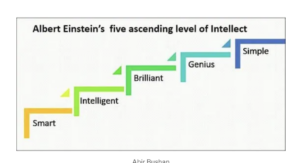
(Source: Link)
How can you reach the rare level of ‘simple’? You will use plain English/layperson’s terms. You’ll convey your ideas using clear language, illustrative stories and appropriate metaphors. In policy work, you’ll add in data and evidence, and go crazy, and add charts and visualisations to help make things easier for the reader.
Win-Win
Reciprocity also teaches you to look for win-win solutions.
If you hear your issue is being considered for the Work Programme, go and meet the people preparing the Work Programme, and go in first, and go in positive. Provide credible solutions and robust evidence to support.
Don’t wait until the initiative is in the Work Programme or tabled by the Commission. The later you step in the lower your chances of influencing anything. Of course, you’ll have a position paper and evidence filed away in your filing cabinet for just tthe moment when your issue comes up on the political agenda.
This cooperative approach won’t work for those who prefer to aggressively haggle like it is a Turkish bazar. But, it is not a Turkish bazar. And, most of the time, they won’t get anything they wanted.
This reciprocity approach is rarely practised, but I’ve found to be successful 98% of the time.
More
Farnam Street, The Great Mental Models, Vol. 2, p.42-57.