This is about trying to estimate, using some math and logic, the likelihood of any specific outcome coming to pass.
It is useful in lobbying. It can help estimate the likelihood of success and recommend actions to increase that positive outcome.
I use this mental model for estimating:
-
Getting the proposal you want
-
Securing the final law you want
-
Win against an EU institution in front of the European Court of Justice
-
Obtain a positive result in front of an EU regulatory agency/scientific committee
-
Secure the right vote from the Member State Committee in comitology votes
-
Get a veto on a comitology measure
Trackers
To help inform, I use a combination of:
-
Tables tracking outcomes for 3,4,5, and 6 accumulated over many years (and the reasons for those outcomes).
-
Looking at voting outcomes via my own records and for anything special, via EU Matrix for 2.
-
For 1, a mix of personal research for files I follow, calls to pen holders/20+ years players in the EP/Council/Commission, and tracking press statements by organisations.
What does the data say
By way of example, as presented to CARACAL, the chances of success before the ECHA RAC on one hazard-ened point are low.
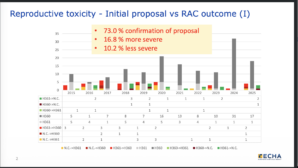
This mirrors my own data (see link). There is around a 2% chance of no classification. This is not surprising. Member State Compentent Authorities only start the hard work for a classification if (1) they think there is a con
Informed Caution
I keep a tracker for 1-6. It makes me cautious and not prone to bouts of wild optimism.
There are actions you can take to increase your chances of success, and just as importantly, a longer list of things you can avoid doing that will increase the chances of failure.
The Sure Thing School of Lobbying
Many lobbyists and lawyers have been inspired by the John Cusack classic, The Sure Thing.
Many are happy to offer a’ guarantee of success’ offer.
The soon-to-be new client is overjoyed get good news. Victory is just around the corner. I guess it is natural to want to hear only good news when dealing with legislative, regulatory, or legal matters.
Very few clients ask for the data that is being used to support the ‘sure thing’ offer of success.
Just as you would not ask a barber if you need a haircut, a client needs to build in checkpoints before they spend a lot of money on a campaign or court case that has a low chance of success.
Guilt
I suffer from Irish Catholic guilt. It forces me to give a cautious and data-driven estimate of the chances of success.
In a moment of unashamed optimism, I went up to 50% chance of success. The client got 95% of what he wanted.
That’s a once in a decade or more event.
You can’t always get what you want
There is one aside, in public policy/law-making, the chances of getting everything you want are low (5% and less). If you set your expectations unrealistically high, the chances of you being disappointed go through the roof.