When you are working in advocacy, you’ll be harnessing:
-
A deep understanding of the process to bring about policy/legislative change.
-
An understanding of the broader policy playbook and political environment.
-
The ability to communicate your asks to the intended audience.
-
The skill set to campaign. Take your asks from a standing start, and make it resonate.
-
Project Management. Get the right resources in place, and deliver at the right time.
-
Issue expertise (optional).
I use the term campaign to mean any effort to change a policy or political decision.
The Standard Brussels Model
Many campaigns in Brussels are led by issue experts.
I sense that there is a genuine belief held by the majority of lobbyists that all that is needed for change to happen is for their expert to speak to the expert(s) in the Commission, Council and the EP, and reason will be seen, and change will happen.
After 29 years in sunny Brussels, I estimate that 90% of campaigns go forward on this basis. And, I have never seen it work.
If a campaign lacks 1,2,3, and can’t access 4 and 5, the campaign is going to fail.
I have not worked with any one person who has all 6 to high standards. You need to establish a team.
Issue experts are easy to find in an issue-focused city. If they can’t communicate their point of view, policy ask and solution to the right audience, at the right time, in a language that the key decision-makers understand, their expertise counts for nothing. In fact, it is a burden, and often the death knell for success.
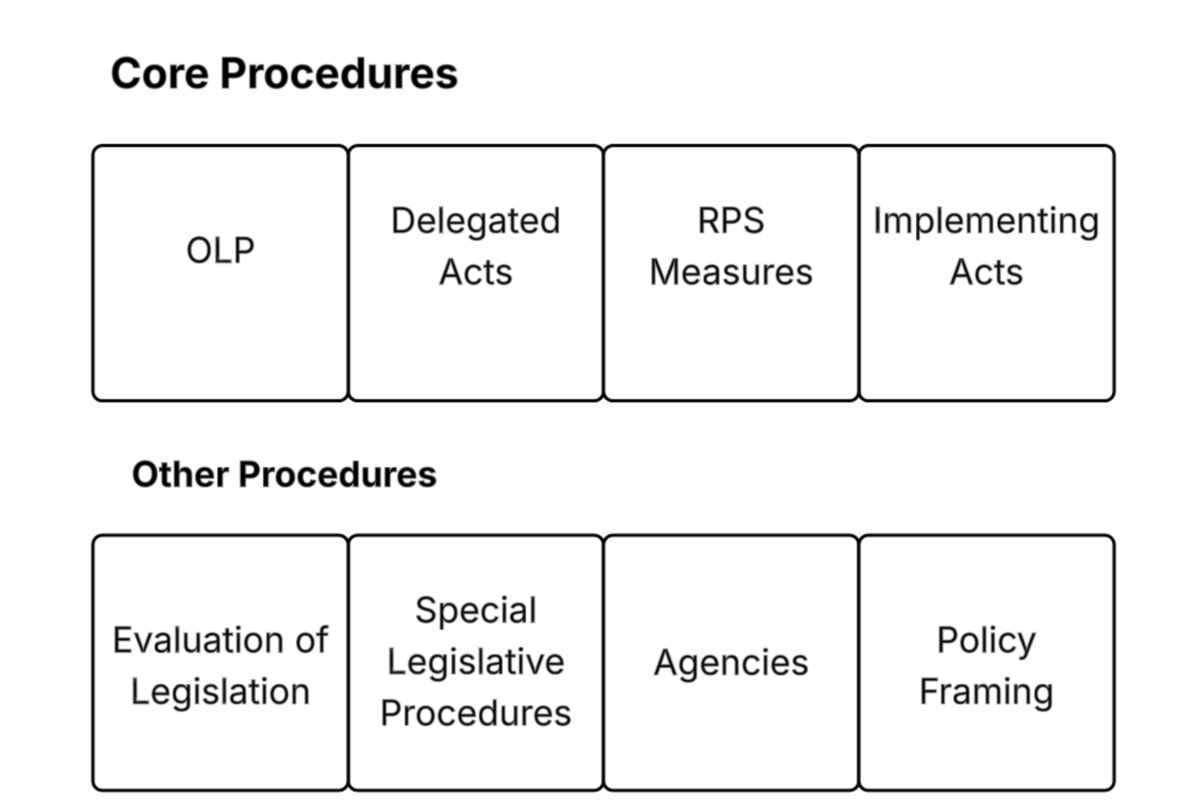
Where do you spend your time time
Your work will likely be spent on one or more of these 8 processes.
I’ve listed Policy framing in one of the boxes. There is surprisingly little of it happening.
In my time in Brussels, I’ve jumped around issues – fisheries, air pollution, waste, and chemicals – but many years ago, I decide to focuse on the procedures for adopting and passing the 7 legislative and policy procedures.
I’ve found that gives you 90-95% of what you need to get the outcome the client wants. The hard part is getting the issue expert to explain the issue in words I can understand.
An Ideal World
In an ideal world – something I don’t believe in – you’d have an advocate who can work on any of these procedures.
The challenge is that, without time and accumulated expertise and experience, working on 8 processes at once, in different areas, will fry most people’s brains.
Just as multitasking does not work, I don’t believe that switching between many procedures and different issues, at the same time, works unless you can (1) deploy models for each of the procedures, (2) based on real expertise, and (3) use systemised best practice recorded in SOPs, checklists, templates and case studies.
Even then, you’ll need an experienced advocate (10-15 years min + real-world experience) to be able to communicate the case to the right people, at the right time, in the right way.
Political Entrepreneurship
The best advocates I’ve worked with were/are excellent political entrepreneurs. They are a rare breed in Brussels.
These people brought together the right collection of people and skills to the table to get the policy/law into place.
They understood the process for bringing about change, could communicate clearly with key decision makers, and made sure that the information being turned out by issue experts was converted into something understandable and useful for bringing about policy and political change.
The 3 of them were excellent campaigners, and brought in excellent campaigners to run campaigns. They also brought project managers to make sure the project got delivered.
And, in only a few cases, were they an issue expert on the file they were working on.
The need to deal with reality
Successful political entrepreneurs are the people who deal with the world as it is, rather than some fairy tale world that many want to dream exists. Only then can you take the actions that need to be taken to get to where you want to be. If you can’t, your chances of success are between 0-1%, just blind luck, and any success will be in spite of what you have done, not because of it.
Leveraging your resources: How to increase your chance of success
I’ve sought to represent the value being brought to the table on any piece of advocacy.
Most people think that the value being brought at each stage is equal.
See figure 1.
My own view is different – see figure 2.
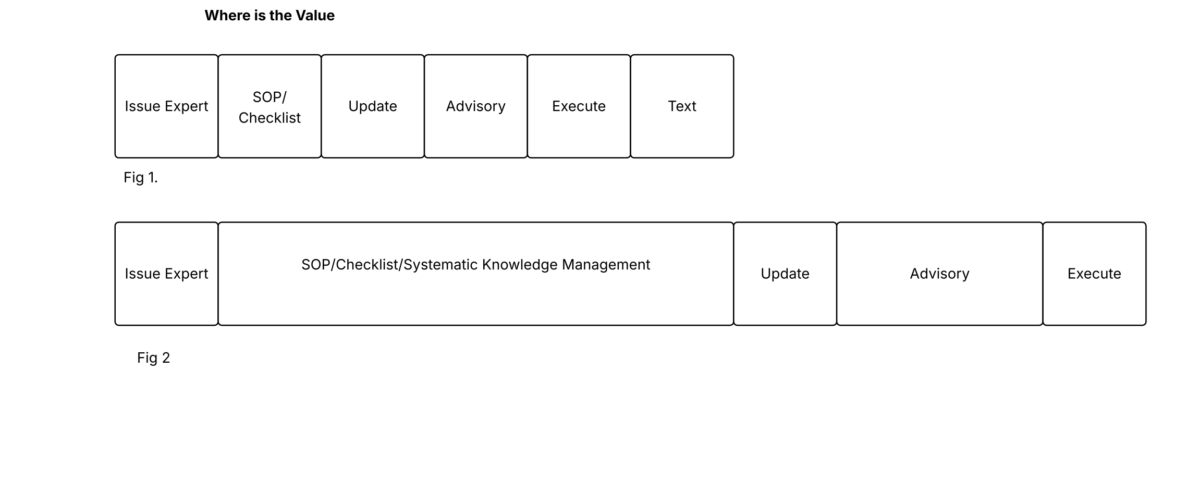
You can increase the value being brought to the table if the issue expert takes what is in their head and systemises best practice down into SOPs, checklists, templates, and case studies.
This leverages the expertise in one person’s head many times over.
It allows other colleagues to re-create what needs to be done by following the best practice laid out in SOPs etc many times. I conservatively estimate between 5-10x.
If the issue expertise is locked away in the head of one person, and they are unable to communicate with other non-experts, the value is of limited value. It can’t be leveraged to bring about change. Their advocacy documents – position papers , speaking points etc – and meetings with officials and politicians will likely create confusion and hostility to your position.
Some issue experts are excellent communicators. I’ve worked with them. When I look back at them, they all got a lot of coaching, rehearsed before going out, and were able to shift the language, examples and metaphors and analogies (they even know what they are) to the audience they are speaking to.
Then your issue expert and others can refine and update the best practice guidance over time.
All of this best practice guidance is worth nothing if it is locked away and does not get used to advise on campaigns. A lot of deep thought needs to go into planning and developing the programme of work to change the law or policy. The resulting advocacy plan should be clear and easily delivered on.
You’ll need a team, including an issue expert, who can communicate with colleagues and decision makers. If they can’t, all the wisdom in the world will be lost. I’ve seen many a winnable case on paper thrown down the drain by people who were unable to communicate clearly and decently with officials, politicians, or the press.
If the assumptions made at the start are wrong, such as a basic misunderstanding of the process, people, the dynamics, or where the initiative is, the chances of success are between low and zero on day one.
Good execution is key. Excellent project managers are essential.