The Commission has now published its proposal. What are you going to do?
Your goal is not to sit in an internal meeting until the proposal is adopted into law or the deadline for amendments has passed.
You can issue press releases of hagiographic praise or a diatribe, but have little real external influence.
Unless you have everything you wanted in the proposal, there is only one thing you can do: work to get amendments tabled to the proposal and get them adopted into law.
This can often be done quickly.
Ready on Day 1
The Commission’s proposal does not appear from the ether. You are not starting from scratch.
You will already have a ‘preferred position’, draft legal text on what you think should be in the law, a viable solution to support your preferred public policy solution, and the evidence and data to support your ask.
You’ve been engaged in lobbying the Commission since they announced the start of work on the proposal. You’ve engaged with the ISSG. The contents of the proposal are not a surprise to you.
All you have to do is update your existing position and your suggested legal text and justifications.
If you only start work once the Commission publish the proposal, you have a steep hill to climb. Unless you were knocked down by a bus and involuntarily incapacitated while the file was being adopted inside the Commission, turning up this late in the day indicates that you have been hibernating, drunk in a ditch, or are simply not well-equipped to influence EU law and policy.
Your Response
I would chunk down a response to any provision into one of the three groups
-
You support the text.
-
You think the text would benefit from some clarification.
-
You object to the text.
And, you can hold all three positions about different parts of a proposal at the same time. There are parts you will welcome, parts you think need clarification, and some you disagree with.
Getting Clarity
You can obtain a better understanding of the meaning of the text in the proposal from:
-
The Explanatory Memorandum
-
The accompanying Impact Assessment
-
The accompanying opinion of the Regulatory Scrutiny Board
-
The preparatory Public Consultations
-
Accompanying studies
Some of these essential documents may not accompany fast-track legislative measures.
The text should be clear. If the text has benefited from Cabinet staff, new to the policy area, trying their legal drafting skills for the first time on a Sunday at 11:30 pm, the legal clarity you are looking for may be missing.
Expectation Management
Don’t live in a fairy tale land where you get everything you want.
In terms of omnibus measures, it is useful to remind yourself that the Commission has seen them as a tool to bring about tweaks to existing measures to deliver simplification, rather than structural policy changes.
Indeed, the Commission’s practice is to withdraw ongoing proposals, even at a late stage, if the amendments from the Council or the European Parliament amount to a significant departure from the Commission’s stated original intent.
Of course, there is nothing to stop you from seeking to bring about substantive change. The only thing you risk is having the whole proposal pulled, and a loss of good faith from many institutional players. That will leave you hibernating in the wilderness for the next 4 years.
Timing
As a general rule, have your amendments ready within eight weeks of the proposal being published. The timeline for short omnibus proposals can be four weeks.
You need your amendments for when the Council Working Group and EP Rapporteur/Shadows start their examination of the proposal.
Don’t produce a knee-jerk response in 24 hours. It may give the game away that you already had the text.
And I’ve known of only a few organisations whose influence is so profound that Commissioners, likely Rapporteurs, and Ministers want to see their public response within 24 hours. You are unlikely to work for them.
Endless procrastination in internal expert meetings seeking an unachievable, perfect set of ‘amendments’ for all your issues is all too common. If you don’t know what your preferred outcome is, the day after the proposal comes out, it is unlikely you’ll be on time to get good quality amendments to MEPs and Member States in time to make a difference.
Sign Off
Your organisation will have a procedure for signing off on its positions and amendments. Follow it
It would be concerning if something as important as putting your ‘considered’ suggested amendments were prepared overnight by a committee of one, without the oversight of the leadership or members. I’ve seen it happen. It is not pretty. It leads to a lot of walking back later on.
Don’t shoot from the hip. You have one chance. You may as well make it count.
If you leave the finalisation of your position and amendments to regulatory experts, you are likely to be signing off your political death warrant. Clarity and grace will be banished from your text. Only fellow regulatory experts will understand them. Few if any decision-makers in the upcoming legislative journey will.
There are exceptions to this general rule. I know three such people.
Your position, amendments, and justifications are intended to be read by politicians, advisers, and civil servants. Some will have done their post-doc on the issue at hand, most won’t. Write clearly for the non-expert.
If you have a pre-existing position, with supporting amendment text, justification, and tangible evidence, you can be good to go the day after the proposal is published. You should get a sign-off from your organisation in advance to go ahead with this. This can be the case when you already have an agreed position, having seen the text go through the Commission, and having an agreed position. And, if the Omnibus proposal is one provision for which you asked for action on, you are likely going to have an agreed position already.
What should the Amendments look like
You’ll be able to draw the basis of your amendments and the accompanying justification from your existing position papers, studies, and evidence.
It can be helpful to have a short policy memo for each set of amendments on an issue to hand over to MEPs, their Advisors, and Member State officials, to explain your request in more detail.
You’ll have developed most of these before the proposal is published. They need to be updated when the proposal is launched.
The following examples illustrate the primary types of amendments, drawn from Committee amendments.
1. New Text: Bold and Italic
Jutta Paulus.
Article 1 – paragraph – point 1(a) new
|
Present text
|
Amendment
|
|
(1a) In Article 1, paragraph 5 is replaced by the following:
|
|
|
This Regulation shall not apply to substances and mixtures in the following forms, which are in the finished state, intended for the final user:
|
“This Regulation shall not apply to human health hazard classes for substances and mixtures in the following forms, which are in the finished state, intended for the final user:‘“
|
(Regulation (EC) 1272/2008)
Justification
All the listed laws only deal with the health effects of chemicals therein, not with the environmental effects. As such, they should only be exempted from CLP with regard to human health hazard classes, but not for environmental hazard classes.
-
Delete the provision in whole
Deleted in bold and italic
|
Text proposed by the Commission
|
Amendment
|
|
(2) From a toxicological point of view, substances with more than one constituent (‘multi-constituent substances’) are no different from mixtures composed of two or more substances. In accordance with Article 13 of Regulation (EC) No 1907/2006 of the European Parliament and of the Council39, aimed to limit animal testing, data on multi-constituent substances is to be generated under the same conditions as data on any other substance, while data on individual constituents of a substance is normally not to be generated, except where individual constituents are also substances registered on their own. Where data on individual constituents is available, multi-constituent substances should be evaluated and classified following the same classification rules as mixtures, unless Annex I to Regulation (EC) No 1272/2008 provides for a specific provision for those multi-constituent substances.
|
deleted
|
|
_________________
|
|
|
39 Regulation (EC) No 1907/2006 of the European Parliament and of the Council of 18 December 2006 concerning the registration, Evaluation, Authorisation and Restriction of Chemicals (REACH), establishing a European Chemicals Agency, amending Directive 1999/45/EC and repealing Council Regulation (EEC) No 793/93 and Commission Regulation (EC) No 1488/94 as well as Council Directive 76/769/EEC and Commission Directives 91/155/EEC, 93/67/EEC, 93/105/EC and 2000/21/EC (OJ L 396, 30.12.2006, p. 1).
|
|
Justification
We propose to delete the definition of ‘multi-constituent substance’ as there is a lack of clarity and alignment with the definition of ‘multi-constituent substance’ under the ECHA Guidance for identification and naming of substances under REACH and CLP. In order to ensure complementarity and legal certainty, ‘multi-constituent substance’ should be defined under REACH and classified under CLP. Substances with more than one constituent (multi-constituent substances) should be considered as single substances and not mixtures. The provision for mixtures is neither adequate, nor usable in the case of natural complex substances (NCSs) – essential oil, plant extract, absolute and so on. In that case, all constituents are integral and inseparable part of the substance. Therefore, the toxicological properties are defined by the entirety of the substance, not by its individual constituents. The composition of the NCSs is complex and often includes a. multitude of constituents. The composition of a natural complex substance depends on nature. It is not an intentional addition of ingredients like a real mixture and this is why the classification criteria for intentional mixtures may fail to provide the correct classification for natural complex substances.
-
Amendment for Practical Clarification
New Bold Italic
|
Text proposed by the Commission
|
Amendment
|
|
In Article 6, paragraph 4a is added:
|
|
|
‘The Agency shall develop robust and timely guidance to support the above mentioned evaluations. All guidance should be adopted before the entry into force of this Regulation.’
|
|
(See paragraph 4, Article 6, Regulation 1272/2008)
Justification
As a principle, guidance for regulations, should be adopted before the entry into force of the regulation, rather than after, to avoid unnecessary implementation challenges
Sources: Link
4. Partial Deletion
.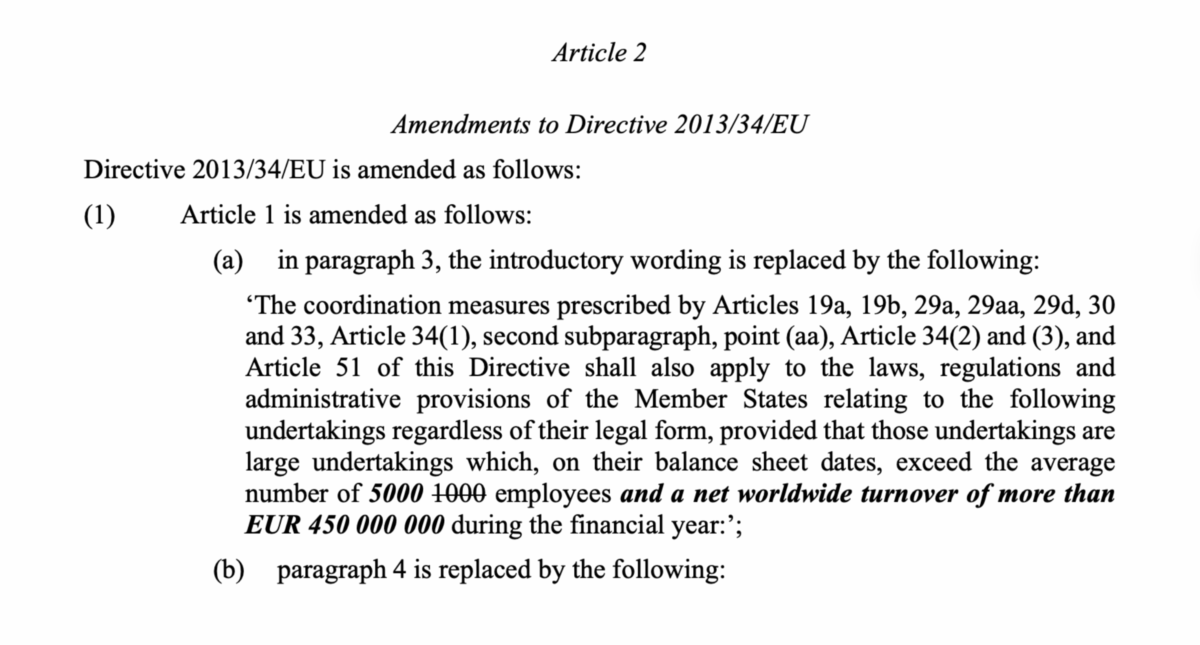
;
Source: Link
Overview
So your amendments package will look something like this:
-
Header: Name of Proposal and COD reference.
-
Start with Recitals and then go Article by Article
-
Mention the provision in bold: e.g. Article 1 – paragraph – point 1(a) new
-
Add in your text with an addition (bold italic), clarification (bold italic), deleting a word/group of words by
strikethrough, or in whole (delete). -
Add a Short Justification. Use plain English. Add A Centred Header of Justification—a few crisp sentences (at most) to make your case.
Some general comments
You are tabling amendments only on the Commission’s proposal.
Short justification
The Justification should be short. It is not necessary. It is a précis of the reason for the proposed legal text above.
You can see from the examples above that there is no common understanding of the term “short”.
Use plain and simple English.
It helps to have evidence to support the request in your amendment. It is useful to have a fact sheet/policy memo for each of your amendments/set of amendments (e.g. aligned definition, recital, and body of the text).
For your policy memo, if you claim that following a practice in fisheries management used in the USA has led to an increase in fish stocks and fishermen’s income, add a table (or 3), showing that from a given date, when a legislative measure started, fish stocks and fishermen’s income increased, and contrast that with fish stocks and fishermen’s income in a comparable EU fisheries. Ensure the data is accurate and that the sources are correctly referenced.
What not to put as a justification
Here are some justifications that I’ve seen that I’d not recommend being explicit about :
- Benefit my country alone.
- Make my company a lot of money.
- Supports my fanatical position on Turtle worship or similar.
- Changing the EU Treaties by the back door is unlikely to work.Try to frame your ask in broader terms. If you claim something, but don’t provide specific examples and sources, most officials and politicians will read what you say and question the veracity of your point. After all, if you continue speaking in generalisations without evidence, it suggests that you are hiding reality.
Getting your amendment tabled and adopted into law
Your hard work is for nothing if your amendment is not tabled and incorporated into the final law.
You’ll need to secure the support of MEPs and Member States to table the text.
I’ll write about this more another day.
I’ve found that seeking the support of a Member State or MEP whose support will undermine the mainstream majority’s support is not the best approach to getting what you want into law.
Tabling amendments to see them voted down is not the goal.